
Understanding Sukuk vs. Conventional Bonds
Kimia Editorial
Kimia Finance Team
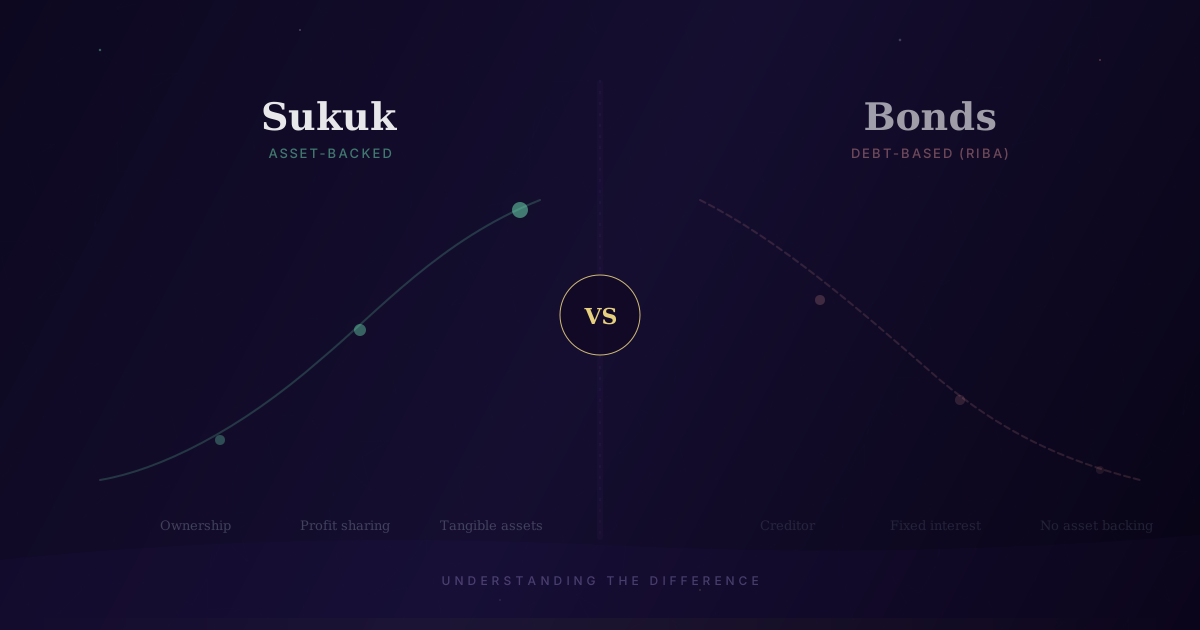
Your advisor recommends bonds for stability. Your faith prohibits interest. Is there an alternative that gives you both?
The answer is Sukuk — and understanding how they differ from conventional bonds is one of the most important distinctions in Islamic finance. Both raise capital from investors, but their legal structure, risk profile, and compliance with Islamic law are fundamentally different.
What Are Conventional Bonds?
A conventional bond is a debt instrument. When you purchase a bond, you are lending money to the issuer — a government or corporation. In return, the issuer pays you periodic interest (coupon payments) and returns the principal at maturity. The interest element makes conventional bonds impermissible under Islamic law (Riba).
What Are Sukuk?
Sukuk (singular: Sakk) are certificates representing proportional ownership in an underlying tangible asset, project, or business venture. Instead of lending money at interest, investors receive a share of the profits generated by the underlying asset. This aligns with the Islamic principle of profit-and-loss sharing (Musharaka).
"Sukuk transform debt financing into asset-backed ownership — a fundamental shift that makes fixed-income investing accessible to Muslims."
Key Differences at a Glance
| Feature | Sukuk | Conventional Bond |
|---|---|---|
| Structure | Ownership certificate in a tangible asset | Debt obligation (IOU) |
| Returns | Profit from asset performance or rent | Fixed interest (Riba) |
| Shariah compliance | Permissible — asset-backed, no interest | Prohibited — interest-based |
| Asset backing | Required — must be tangible & Halal | Not required |
| Risk sharing | Investor shares in asset performance | Issuer bears all risk; investor gets fixed rate |
| In case of default | Investor has claim on underlying asset | Bondholder is a creditor with priority claims |
| Market size | ~$800B+ outstanding globally | $100+ trillion globally |
Common Sukuk Structures
The most widely used Sukuk structures include Ijara (lease-based), where investors own and lease an asset; Murabaha (cost-plus sale); and Musharaka (partnership), where investors co-own a business venture. Each carries different risk-return characteristics.
Types of Sukuk in Detail
The Sukuk market has evolved to offer several distinct structures, each with different risk-return characteristics:
- Ijara Sukuk (Lease-based): The most common structure. A Special Purpose Vehicle (SPV) buys an asset and leases it to the originator. Investors receive rental payments. At maturity, the originator repurchases the asset. These are relatively predictable and low-risk — suitable for income-seeking investors.
- Murabaha Sukuk: Based on a cost-plus-profit sale of a specific commodity. Returns are fixed in advance, making them the most bond-like in behavior. However, some scholars flag these as less authentic to the spirit of Islamic finance since the profit is essentially predetermined.
- Musharaka Sukuk: Represents partnership ownership in a project or venture. Returns vary based on actual performance — both profit and loss are shared. Higher risk, higher potential return, and considered by many scholars the most genuinely Islamic structure.
- Istisna Sukuk: Used to finance construction or manufacturing projects. Investors fund a project under development; returns begin once the asset is generating revenue. Common for infrastructure projects in Gulf countries.
- Wakala Sukuk: The SPV appoints an agent (Wakeel) to invest funds on investors' behalf. Returns are based on the agent's investment performance. Common in the UK Islamic banking market.
Government vs. Corporate Sukuk
Like conventional bonds, Sukuk come in two main categories:
Sovereign Sukuk (government-issued) from countries like Malaysia, Saudi Arabia, Indonesia, the UAE, and even the UK (which has issued Sukuk since 2014) carry the credit backing of their respective governments. They are generally lower risk and are used by Islamic institutions and pension funds as core fixed-income holdings.
Corporate Sukuk are issued by companies to finance specific projects or general capital needs. They offer higher yields to compensate for higher credit risk. Examples include Sukuk from airlines, banks, property developers, and infrastructure companies across the Muslim world and beyond.
"The $800 billion global Sukuk market has proven that Islamic finance can fund nation-building — from airports to power plants — without a single dirham of interest."
How to Access Sukuk as a Retail Investor
Retail access to Sukuk varies by country. Here are the main routes:
- Retail Sukuk programs: Malaysia's government offers retail Sukuk (SR Sukuk) to individual investors in small denominations. Saudi Arabia has similar programs. These are listed on local exchanges and purchasable through banks.
- Sukuk ETFs and funds: The easiest route for most Western-based Muslim investors. Funds like the iShares Global Sukuk ETF (ISUS) provide diversified exposure to investment-grade Sukuk with the liquidity of exchange trading. Minimum investment can be as low as a single ETF share.
- Islamic investment platforms: Some fintech platforms in the UK, UAE, and Malaysia allow retail Sukuk investment with lower minimums than traditional brokerage accounts.
- Through Islamic banks: Many Islamic banks offer Sukuk as part of their investment product range, sometimes as fixed-term deposits that invest in specific Sukuk.
Risks You Should Know
Sukuk are not risk-free. Key risks include:
- Credit risk: The originator or SPV may default, as seen in some high-profile corporate Sukuk defaults in the Gulf. Sovereign Sukuk carry lower but non-zero credit risk.
- Shariah compliance risk: Not all Sukuk are equally compliant. Structures that are technically Shariah-certified may still be criticized by some scholars. Review the Shariah board and structure before investing.
- Liquidity risk: Many Sukuk trade less actively than conventional bonds, meaning you may not find a buyer immediately if you need to exit before maturity.
- Currency risk: Many sovereign Sukuk are denominated in USD or the issuing country's currency. Exchange rate movements affect your real returns.
Zakat on Sukuk
Sukuk holdings are part of your Zakatable wealth. For Ijara Sukuk held as investments: include the current market value of your Sukuk on your Zakat anniversary date. For profit distributions received: these are added to your other Zakatable assets. If you hold Sukuk in a fund, the fund's NAV per unit is your reference value.
As the global Sukuk market has surpassed $800 billion in outstanding issuance, they represent one of the most mature and accessible Halal investment options available. Kimia helps you track your Sukuk holdings, expected distributions, and contribution to your annual Zakat calculation — all in one place.
Bottom line: if you want fixed-income exposure without interest, Sukuk is not a compromise — it is the original. Start with a Sukuk ETF like iShares ISUS, and build from there.
Related reading: Halal passive income ideas, Halal ETFs guide, and Kimia Pro.
Master Your Money the Halal Way
Get weekly tips on ethical investing and financial purification delivered to your inbox.
Share this article
Apply What You Learned
Track your finances, manage Qard al-Hasana, and plan your budget with Kimia.
Try Kimia Free