
Islamic Estate Planning: Passing Wealth to the Next Generation the Right Way
Kimia Editorial
Kimia Finance Team
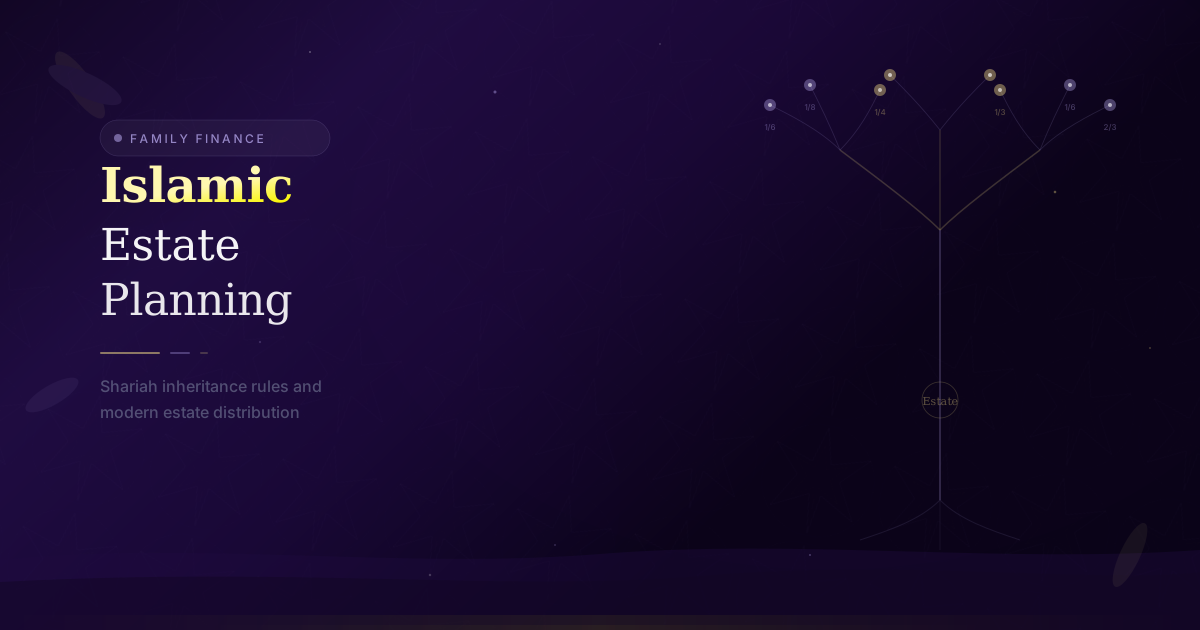
Here is a difficult truth: the majority of Muslim families in Western countries die without a will. Their estates pass according to local civil law — not Islamic inheritance law — and often result in exactly the distribution that Islamic law was designed to prevent: wealth concentrated arbitrarily, dependents unsupported, and family relationships damaged by financial disputes.
Islam does not treat inheritance as an afterthought. The Quran dedicates more specific text to inheritance rules than to almost any other financial topic. The rules of Mirath (Islamic inheritance) represent 1,400 years of jurisprudence designed to protect families. Modern estate planning allows you to honor these rules even in countries where they are not legally recognized.
The Basics of Islamic Inheritance (Mirath)
Islamic inheritance law specifies fixed shares for each class of heir. Key principles:
- Asabah (residuary heirs): After specific shares are allocated, the remainder goes to the nearest male relative in the paternal line
- Daughters receive half the share of sons from the same father — but this must be understood in context: daughters have no Nafaqah obligation to support others, while sons do
- Spouses receive fixed shares: A widow receives 1/8 if there are children, 1/4 if none; a widower receives 1/4 or 1/2 respectively
- Parents are protected: Each parent receives at minimum 1/6 if there are children
- Non-Muslim relatives: Do not inherit from a Muslim estate under classical Mirath rules
These rules interact in complex ways — a qualified Islamic scholar or an estate planning attorney familiar with Islamic law should be consulted for your specific family situation.
"A man may do good deeds for seventy years but if he acts unjustly when leaving his last testament, the wickedness of his deed will be sealed upon him." — Hadith, Abu Dawud
The Wasiyya: Your Islamic Will
Up to one-third of your estate may be distributed via Wasiyya — a bequest — to non-heirs or charitable causes. The remaining two-thirds (at minimum) must follow Mirath rules for designated heirs.
The Wasiyya is a powerful tool for:
- Leaving something to a non-Muslim family member who would not otherwise inherit
- Supporting a charitable cause (Waqf endowment)
- Providing for step-children or other dependents not covered by Mirath
- Distributing specific assets (a family home, a business) to a specific heir outside the proportional shares
The Challenge in Non-Muslim Countries
If you live in the UK, USA, Canada, or Europe and die without a valid will, your estate passes according to local intestacy laws. These laws distribute your estate to your "next of kin" — a legal concept that may not align with your actual heirs or wishes.
The solution is a legally valid will that instructs your estate to be distributed according to Islamic principles. In most Western countries, this is entirely legal — you can specify in your will that your estate should be distributed "according to the rules of Islamic inheritance as I understand them," or provide the exact shares.
Work with a solicitor (UK) or attorney (USA/Canada) who has experience with Islamic wills. Several organizations provide template Islamic wills that are legally enforceable in major jurisdictions.
Key Assets to Plan For
- Property: Does it pass outside your will (joint tenancy) or through your estate (tenancy in common)? Joint tenancy bypasses your will entirely — which may or may not align with Islamic law depending on your heir structure.
- Pensions and life insurance: These typically pass by beneficiary designation, not through your will. Update your designated beneficiaries explicitly.
- Business interests: Partnerships and shareholdings require specific planning to prevent forced liquidation at your death.
- Overseas assets: Property in Pakistan, Turkey, Egypt, or elsewhere is governed by the laws of that country — not your country of residence. Separate planning may be required.
- Digital assets: Cryptocurrency wallets, online accounts, and digital investments require specific access instructions in your estate plan — without them, these assets may be permanently lost.
Waqf: The Islamic Endowment
A Waqf (charitable endowment) allows you to set aside assets — property, cash, investments — that generate ongoing returns for charitable purposes in perpetuity. The assets themselves are "locked" from inheritance; only the income flows to designated beneficiaries (family or charitable causes).
Waqf is increasingly accessible to ordinary Muslims through Islamic finance institutions and legal structures in the UK and North America. The spiritual rewards of a Waqf continue after death — a continuous Sadaqah Jariyah.
Getting Started
- Calculate your current estate: assets minus liabilities
- Identify your heirs under Islamic law
- Decide your Wasiyya (up to 1/3 of estate)
- Write a legally valid will with an attorney experienced in Islamic wills
- Update all beneficiary designations on pensions, insurance, and accounts
- Review every 3-5 years or after major life changes
Kimia helps with step one: tracking your complete financial picture in one place so you know exactly what your estate consists of. When you work with an estate planning professional, your Kimia data gives them an accurate starting point rather than having to reconstruct years of financial history.
Related reading: family budget guide, wealth building strategies, and Kimia Pro.
Master Your Money the Halal Way
Get weekly tips on ethical investing and financial purification delivered to your inbox.
Share this article
Apply What You Learned
Track your finances, manage Qard al-Hasana, and plan your budget with Kimia.
Try Kimia Free