
Financial Metrics That Actually Matter: A Complete Guide to Understanding Your Numbers
Kimia Editorial
Kimia Finance Team
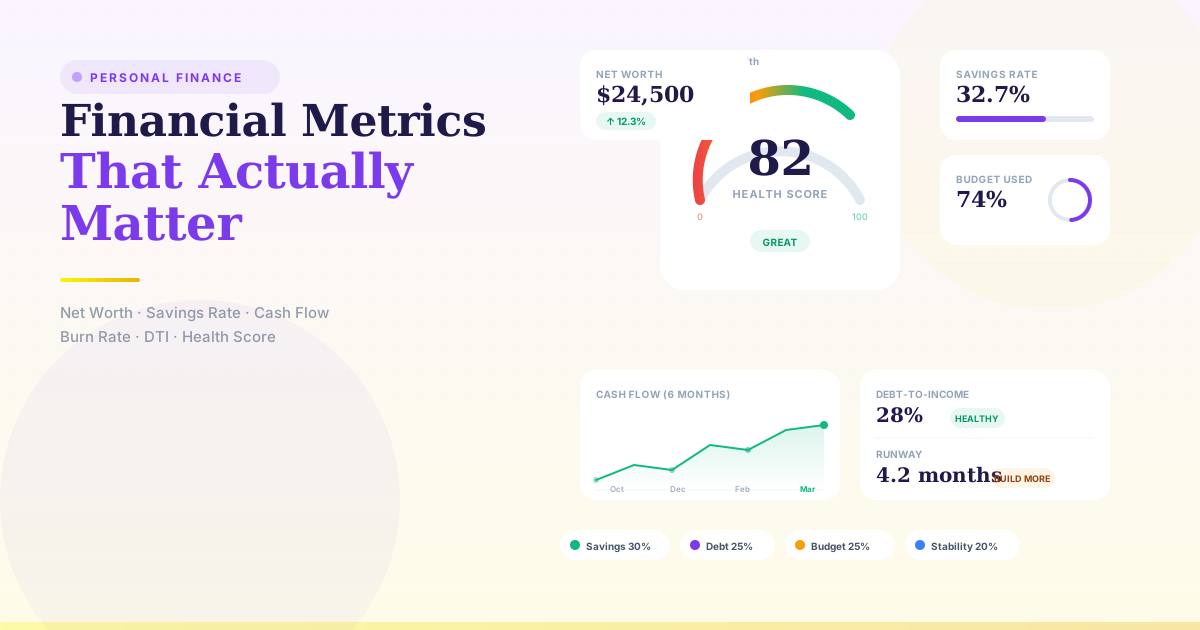
Your finance app is full of numbers. Account balances, net worth, savings rate, cash flow, budget performance, debt ratios, health scores — each one tells a different part of your financial story. But which ones actually matter? What do they mean? And what should you do when a number turns red?
This guide explains every major financial metric from the ground up, with formulas, worked examples, and clear benchmarks. By the end, you will understand not just what each number shows, but how they all connect — and how a single change ripples through your entire financial picture.
Account Balance: The Simplest Metric
Your account balance is the most basic financial number: how much money is in a specific account right now.
Formula: Starting Balance + All Inflows − All Outflows = Current Balance
Every income transaction, expense, transfer, and adjustment that touches the account changes its balance. It is the running total of everything that has ever happened in that account.
When to Worry
- Negative balance: For a bank account, this means you are in overdraft — you are spending money you do not have. For a credit card, a negative balance (from the app's perspective as a liability) is normal and represents what you owe.
- Rapid decline: If your checking account balance is dropping noticeably faster than usual, something has changed — either your income decreased or your spending increased. Investigate before the balance hits zero.
- Stagnant balance: If your savings account balance has not grown in months, your savings rate may be too low. Check your net earnings.
Account balance is useful but limited. It tells you about one account in isolation. To understand your full financial position, you need net worth.
Net Worth: The Only Number That Tells the Full Story
Formula: Total Assets − Total Liabilities = Net Worth
Net worth is the single most important number in personal finance. It answers the question: "If I sold everything I own and paid off everything I owe, how much would I have left?"
The Key Insight
Most people misunderstand what changes net worth. Here is the truth:
- Buying gold does not change your net worth. You lose $5,000 cash but gain $5,000 in gold. Net effect: zero. The money just changed form.
- Borrowing money does not change your net worth. You gain $10,000 cash but also gain a $10,000 liability. Net effect: zero.
- Only income increases net worth. When you earn $4,000 in salary, your bank balance goes up by $4,000 with no offsetting liability. Net worth goes up.
- Only expenses decrease net worth. When you pay $1,200 for rent, that money is gone — consumed — with no offsetting asset. Net worth goes down.
Net Worth Impact Table
| Action | Effect on Net Worth | Why |
|---|---|---|
| Receive salary ($4,000) | Increases by $4,000 | New money, no offsetting liability |
| Pay rent ($1,200) | Decreases by $1,200 | Money consumed, no asset received |
| Buy gold ($2,000) | No change | Cash becomes gold — asset form changes |
| Take a loan ($10,000) | No change | Cash gained = liability created |
| Pay off credit card ($500) | No change | Cash lost = liability removed |
| Receive a gift ($200) | Increases by $200 | New money, no obligation to return |
| Pay loan interest ($150) | Decreases by $150 | Money paid with no debt reduction |
"Net worth is the single number that answers 'am I making progress?' Everything else is detail."
Net Earnings and Savings Rate
Net Earnings Formula: Total Income − Total Expenses = Net Earnings
Savings Rate Formula: (Net Earnings / Total Income) × 100 = Savings Rate %
Net earnings tell you how much of your income you kept. The savings rate converts that into a percentage so you can compare across months and income levels.
Worked Example
Suppose your monthly finances look like this:
- Salary: $4,000
- Rent: $1,200
- Groceries: $400
- Transportation: $200
- Utilities: $150
- Subscriptions: $50
- Dining out: $200
- Miscellaneous: $100
Total expenses: $2,300. Net earnings: $4,000 − $2,300 = $1,700. Savings rate: $1,700 / $4,000 = 42.5%.
Savings Rate Benchmarks
| Savings Rate | Assessment |
|---|---|
| > 30% | Excellent — you are building wealth rapidly |
| 20% – 30% | Good — solid foundation for long-term goals |
| 10% – 20% | Average — enough for basic emergency savings |
| < 10% | Weak — very little buffer for unexpected expenses |
| Negative | Danger — you are spending more than you earn |
Important Notes
Only transactions in liquid accounts (cash and bank accounts) count toward the savings rate. Transfers, starting balances, and adjustments are excluded — they do not represent real income or real expenses. Kimia calculates your savings rate automatically, filtering out non-income and non-expense transaction types so the number is always accurate.
Cash Flow: Where It Comes From, Where It Goes
Cash flow goes beyond income and expenses to show the complete picture of money movement. It answers: "Where did all my cash come from this month, and where did it all go?"
Three Categories of Cash Flow
- Operational cash flow: Your day-to-day financial life — salary coming in, rent and groceries going out. This is income minus expenses.
- Investing cash flow: Money moving between your liquid and non-liquid accounts — buying gold (outflow), selling stocks (inflow), purchasing property (outflow).
- Financing cash flow: Money related to debt — receiving a loan (inflow), repaying a loan principal (outflow), borrowing from family (inflow).
Worked Monthly Example
| Category | Inflows | Outflows | Net |
|---|---|---|---|
| Operational | $4,000 (salary) | $2,300 (expenses) | +$1,700 |
| Investing | $0 | $500 (gold purchase) | −$500 |
| Financing | $0 | $300 (loan principal) | −$300 |
| Total Cash Flow | $4,000 | $3,100 | +$900 |
Notice that your net cash flow (+$900) is lower than your net earnings (+$1,700). That is because $500 went to gold and $300 went to loan repayment — both of which preserve or increase your net worth but reduce your liquid cash.
Key insight: Negative cash flow is not necessarily bad. If you are investing heavily or paying down debt, your cash flow may be negative even though your net worth is growing. The danger signal is negative operational cash flow — that means your everyday expenses exceed your income.
Burn Rate and Runway: How Long Can You Survive?
These two metrics answer the most practical emergency question: "If all income stopped today, how many days could I survive on what I have?"
Burn Rate Formula: Total Operational Expenses / Number of Days = Daily Burn Rate
Runway Formula: Total Liquid Cash / Daily Burn Rate = Runway (in days)
Example
If your monthly operational expenses are $2,300 and you have $15,000 in liquid accounts:
- Daily burn rate: $2,300 / 30 = $76.67 per day
- Runway: $15,000 / $76.67 = 196 days (about 6.5 months)
Runway Benchmarks
| Runway | Assessment |
|---|---|
| > 6 months | Excellent — you have a strong emergency fund |
| 3 – 6 months | Good — meets most financial advisor recommendations |
| 1 – 3 months | Warning — one unexpected event could cause serious trouble |
| < 1 month | Dangerous — you are living paycheck to paycheck |
"Runway answers the most important emergency question: if everything stops today, how long do I have?"
Kimia calculates your burn rate and runway automatically based on your recent spending patterns, updating daily as new transactions are recorded.
Budget Performance: Controlling What You Can
A budget sets a spending limit for a given category over a given period. Budget performance measures how well you stuck to that limit.
Formula: (Actual Spending / Budgeted Amount) × 100 = Budget Performance %
Benchmarks
| Performance | Assessment |
|---|---|
| < 80% | Excellent — significantly under budget, consider if the budget is too generous |
| 80% – 100% | Good — on track, spending within planned limits |
| 100% – 110% | Warning — slightly over budget, minor course correction needed |
| > 110% | Overspent — meaningful overrun, review and adjust either spending or the budget itself |
Success Rate Across Categories
Individual category performance is useful, but the real question is: "What percentage of my budget categories stayed within limit?" If you have 10 budget categories and 8 of them came in at or under 100%, your budget success rate is 80%. Track this monthly — it is a better indicator of overall discipline than any single category.
Debt Analytics: DTI and Repayment Strategy
Debt-to-Income Ratio (DTI)
Formula: (Monthly Debt Payments / Monthly Gross Income) × 100 = DTI %
DTI tells lenders — and you — how much of your income is already committed to debt repayment.
| DTI | Assessment |
|---|---|
| < 20% | Excellent — plenty of room for savings and spending |
| 20% – 35% | Good — manageable, but watch for increases |
| 35% – 50% | Warning — a significant portion of income is locked into debt |
| > 50% | Dangerous — more than half your income goes to debt; high risk of financial distress |
Debt-to-Asset Ratio
Formula: Total Liabilities / Total Assets = Debt-to-Asset Ratio
A ratio above 1.0 means you owe more than you own — your net worth is negative. A ratio below 0.5 is generally considered healthy.
Repayment Strategies
- Avalanche method: Pay minimums on all debts, then throw every extra dollar at the debt with the highest interest rate. Mathematically optimal — saves the most money in total interest paid.
- Snowball method: Pay minimums on all debts, then throw every extra dollar at the debt with the smallest balance. Psychologically motivating — you see debts disappear faster, which builds momentum.
Amortization: The Hidden Structure
In amortized loans (mortgages, car loans, many personal loans), each payment contains both principal and interest. Early in the loan, payments are mostly interest. Later, payments are mostly principal. This means:
- In year 1 of a 30-year mortgage, perhaps 70% of your payment is interest (a real expense) and 30% is principal (a transfer that reduces debt)
- In year 25, perhaps 90% is principal and only 10% is interest
- Extra payments early in the loan save dramatically more interest than extra payments later
Balance Sheet: Your Financial Snapshot
A balance sheet organizes everything you own and owe into a structured view at a single point in time.
Asset Classification
- Current assets (liquid): Cash, checking accounts, savings accounts — things you can spend immediately
- Non-current assets (illiquid): Gold, investments, property, receivables — things that need to be sold or converted first
Liability Classification
- Current liabilities (short-term): Credit card balances, bills due, short-term loans — debts due within a year
- Long-term liabilities: Mortgages, student loans, multi-year financing — debts extending beyond a year
Key Financial Ratios
| Ratio | Formula | Healthy Range |
|---|---|---|
| Current Ratio | Current Assets / Current Liabilities | > 2.0 |
| Quick Ratio | Liquid Assets / Current Liabilities | > 1.0 |
| Debt Ratio | Total Liabilities / Total Assets | < 0.5 |
Worked Example
| Category | Amount |
|---|---|
| Current Assets | |
| Checking account | $5,000 |
| Savings account | $10,000 |
| Cash | $200 |
| Non-Current Assets | |
| Gold | $8,000 |
| Investment portfolio | $12,000 |
| Total Assets | $35,200 |
| Current Liabilities | |
| Credit card | $1,500 |
| Long-Term Liabilities | |
| Car loan | $8,000 |
| Total Liabilities | $9,500 |
| Net Worth | $25,700 |
Current ratio: $15,200 / $1,500 = 10.1 (excellent). Quick ratio: $15,200 / $1,500 = 10.1 (same, since all current assets are liquid). Debt ratio: $9,500 / $35,200 = 0.27 (healthy).
Financial Health Score: One Number, Four Factors
A financial health score condenses your entire financial situation into a single number between 0 and 100. It is calculated from four weighted components:
| Factor | Weight | What It Measures |
|---|---|---|
| Savings | 30% | Your savings rate relative to benchmarks |
| Debt | 25% | Your debt-to-income ratio and debt-to-asset ratio |
| Budget | 25% | Your budget adherence across categories |
| Income Stability | 20% | Consistency of income over recent months |
Worked Example
Using the numbers from our earlier examples:
- Savings score: 42.5% savings rate is excellent → 95 out of 100
- Debt score: DTI is moderate, debt ratio is 0.27 → 75 out of 100
- Budget score: 80% success rate across categories → 80 out of 100
- Income stability: Steady salary, no missed months → 90 out of 100
Health Score = (95 × 0.30) + (75 × 0.25) + (80 × 0.25) + (90 × 0.20) = 28.5 + 18.75 + 20 + 18 = 85.25
Score Interpretation
| Score | Assessment |
|---|---|
| 80 – 100 | Excellent — strong financial position, maintain your habits |
| 60 – 79 | Good — solid foundation with room for improvement |
| 40 – 59 | Average — some areas need attention |
| 0 – 39 | Needs attention — significant financial stress, prioritize stabilization |
Islamic Financial Health Score
For Muslims who want their financial health score to reflect their spiritual values alongside material wellbeing, Kimia offers an Islamic Financial Health Score built on eight faith-aligned factors:
- Zakat compliance: Have you calculated and paid your Zakat accurately and on time? This measures whether you fulfill the third pillar of Islam from a financial perspective — not just whether you paid something, but whether you paid the correct amount based on your full Zakatable wealth.
- Riba avoidance: What percentage of your financial dealings are free from interest? This includes bank accounts, loans, credit cards, and investments. A score of 100% means fully Shariah-compliant; anything less indicates areas to work on.
- Sadaqah rate: Beyond obligatory Zakat, how much voluntary charity do you give as a percentage of your income? Even small, consistent Sadaqah is valued — the metric rewards regularity over amount.
- Emergency fund adequacy: Do you have sufficient reserves to handle unexpected expenses without resorting to interest-based borrowing? This aligns with the Islamic principle of prudent planning and self-sufficiency.
- Islamic debt ratio: Islamic scholars have long advised that personal debt should not exceed one-third of one's wealth — a principle rooted in moderation. This factor measures your total liabilities against your total assets with the one-third threshold as the benchmark.
- Halal income diversity: How many independent streams of Halal income do you have? Diversification reduces vulnerability and aligns with the Prophetic encouragement to seek provision through multiple means.
- Hajj planning: If Hajj is not yet completed, are you actively saving toward it? This factor rewards intentional financial planning for one of Islam's five pillars.
- Financial discipline: Do you track your spending consistently, stick to budgets, and make financial decisions deliberately rather than impulsively? Discipline is the foundation that makes all other factors sustainable.
Each factor is scored individually and combined into a composite score. The Islamic Health Score is shown alongside the standard financial health score — they complement each other rather than replacing one another.
The Cascade Effect: How One Change Ripples Through Everything
Financial metrics are not isolated numbers. They form a connected system where a single change can cascade through multiple metrics simultaneously.
Example: A $500/Month Expense Increase
Suppose you move to a more expensive apartment, adding $500/month to your rent. Watch the cascade:
- Expenses increase by $500/month
- Net earnings drop from $1,700 to $1,200
- Savings rate drops from 42.5% to 30%
- Cash flow decreases by $500 each month
- Burn rate increases from $76.67/day to $93.33/day
- Runway shortens from 196 days to 161 days
- Budget performance worsens in the housing category
- Health score drops as savings and budget components decrease
One decision. Eight metrics affected. This is why understanding the connections between metrics matters more than memorizing individual formulas.
Reverse Example: Paying Off a Loan
Now suppose you finish paying off a $300/month car loan:
- Debt payments decrease by $300/month
- DTI improves immediately
- If the $300 is redirected to savings: Net earnings increase, savings rate rises, cash flow improves, runway extends
- Debt ratio drops as the liability disappears from your balance sheet
- Health score improves across debt, savings, and budget components
This positive cascade is why aggressive debt repayment has such a dramatic effect on overall financial health — it does not just remove a single payment, it improves nearly every metric you track.
The best way to see these connections in action is to use a tool that calculates all your metrics in one place. Kimia updates every metric in real time as you add transactions, so you can see the cascade effect as it happens — not weeks later when you pull a spreadsheet together.
Master Your Money the Halal Way
Get weekly tips on ethical investing and financial purification delivered to your inbox.
Share this article
Apply What You Learned
Track your finances, manage Qard al-Hasana, and plan your budget with Kimia.
Try Kimia Free